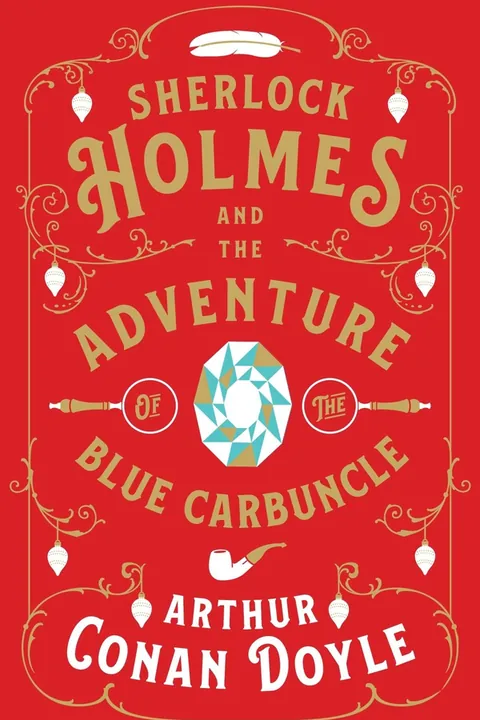
The Adventure of the Blue Carbuncle El carbunclo azul
Es la segunda mañana después de Navidad. A manos de Sherlock Holmes llegan un sombrero gastado y un ganso de Navidad que un desconocido dejó tirados en la calle por la noche. Con solo examinar el sombrero, Holmes deduce todo sobre su dueño, y en el buche del ganso aparece el carbunclo azul de la condesa de Morcar, por cuyo robo ya arrestaron a un fontanero. Holmes sigue el rastro del ganso: una taberna, el mercado de Covent Garden, una apuesta con un vendedor terco. Un misterio navideño en el que no matan a nadie.
LeerEl comienzo en inglés, nivel A2, con traducción
It was the second morning after Christmas. I went to see my friend Sherlock Holmes. I wanted to wish him the joy of the season.
Era la segunda mañana después de Navidad. Fui a visitar a mi amigo Sherlock Holmes. Quería desearle la alegría de las fiestas.
He lay on the sofa in a purple dressing-gown. His pipe-rack stood on the right, within his reach. Near his hand lay a pile of morning papers, all crumpled: he read them every one before I came.
Él estaba tumbado en el sofá, con un batín morado. Su portapipas estaba a la derecha, a su alcance. Cerca de su mano había un montón de periódicos de la mañana, todos arrugados: él los leyó todos antes de que yo llegara.
Beside the sofa there was a wooden chair, and on the corner of its back hung a hat. It was a hard black hat, very old and very dirty. It was cracked in several places.
Junto al sofá había una silla de madera, y de una esquina del respaldo colgaba un sombrero. Era un sombrero negro y duro, muy viejo y muy sucio. Estaba agrietado en varios sitios.
A lens and a forceps lay on the seat of the chair. So the hat hung there for a reason. Holmes was studying it.
Sobre el asiento de la silla había una lupa y unas pinzas. Así que el sombrero colgaba allí por algo. Holmes lo estaba estudiando.
“You are busy,” said I. “Perhaps I interrupt you.”
—Está usted ocupado —dije—. Quizá lo interrumpo.
“Not at all. I am glad to have a friend here, and I can talk about my results with you. The thing itself is a very small one”—he pointed his thumb at the old hat—“but there are points in it. They are interesting, and even useful to learn from.”
—En absoluto. Me alegra tener aquí a un amigo, y puedo hablar de mis resultados con usted. La cosa en sí es muy pequeña —señaló con el pulgar el viejo sombrero—, pero hay en ella detalles. Son interesantes, e incluso útiles para aprender.
I sat down in his armchair and warmed my hands at his crackling fire. A sharp frost came in the night, and the windows were thick with ice crystals.
Me senté en su sillón y me calenté las manos junto a su fuego crepitante. Por la noche cayó una fuerte helada, y las ventanas estaban cuajadas de cristales de hielo.
“I suppose,” I said, “that this homely thing has some deadly story behind it. It is the clue which will lead you to a mystery and to the punishment of a crime.”
—Supongo —dije— que este humilde objeto tiene detrás alguna historia siniestra. Es la pista que lo llevará a un misterio y al castigo de un delito.
“No, no. No crime,” said Sherlock Holmes, laughing. “Only one of those strange little happenings. Four million people live here, and they all push against each other in a few square miles.
—No, no. Ningún delito —dijo Sherlock Holmes, riendo—. Solo uno de esos pequeños sucesos extraños. Aquí viven cuatro millones de personas, y todas se empujan unas a otras en unas pocas millas cuadradas.
“In such a thick crowd every kind of thing must happen. Many little problems come up. They can be odd and surprising, and still there is no crime in them. We have seen such cases before.”
—En una multitud tan densa tiene que ocurrir toda clase de cosas. Surgen muchos pequeños problemas. Pueden ser raros y sorprendentes, y aun así no hay delito en ellos. Hemos visto casos así antes.
“That is true,” I said. “I have added six cases to my notes lately, and in three of them there was no crime at all.”
—Es cierto —dije—. Últimamente he añadido seis casos a mis notas, y en tres de ellos no había ningún delito en absoluto.
“Precisely. You mean the Irene Adler papers, and the case of Miss Mary Sutherland, and the man with the twisted lip. Well, I am sure that this little matter is just as innocent. You know Peterson, the commissionaire?”
—Exactamente. Se refiere usted a los papeles de Irene Adler, y al caso de la señorita Mary Sutherland, y al hombre del labio retorcido. Bueno, estoy seguro de que este pequeño asunto es igual de inofensivo. ¿Conoce usted a Peterson, el recadero?
“Yes.”
—Sí.
“That prize belongs to him.”
—Ese trofeo le pertenece a él.
“It is his hat.”
—Es su sombrero.
“No, no, he found it. Nobody knows its owner. Please do not look at it as an old broken hat. Look at it as a problem for the mind. And first, how did it come here? It came on Christmas morning, together with a good fat goose. That goose is roasting in front of Peterson’s fire at this moment, I have no doubt.
—No, no, él lo encontró. Nadie conoce a su dueño. Por favor, no lo mire como un sombrero viejo y estropeado. Mírelo como un problema para la mente. Y, en primer lugar, ¿cómo llegó aquí? Llegó la mañana de Navidad, junto con un buen ganso cebado. Ese ganso se está asando delante del fuego de Peterson en este momento, no me cabe duda.
Sigue leyendo en Readin: