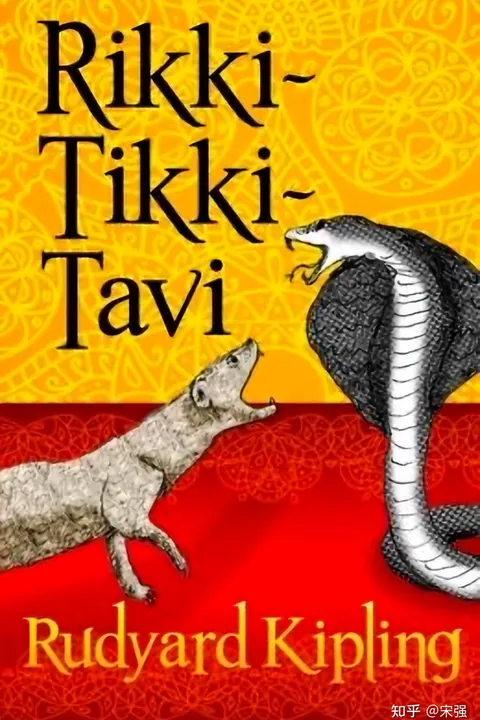
Rikki-Tikki-Tavi Rikki-Tikki-Tavi
Una crecida de verano arrastra a Rikki-tikki, una mangosta joven, hasta la puerta de una casa inglesa en la India, y la familia decide quedarse con él. En el jardín mandan las cobras Nag y Nagaina, y la vida entera de una mangosta consiste en pelear con serpientes. Uno contra dos, de noche, en un baño ajeno, y del desenlace depende que el pequeño Teddy llegue vivo a la mañana.
LeerEl comienzo en inglés, nivel A2, con traducción
At the hole where he went in
Junto al agujero en que entró
Red-Eye called to Wrinkle-Skin.
Ojo Rojo a Piel Arrugada llamó.
Hear what little Red-Eye says:
Oye lo que dice el pequeño Ojo Rojo:
“Nag, come up and dance with death!”
«¡Nag, sube y baila con la muerte!».
Eye to eye and head to head,
Ojo a ojo y cabeza a cabeza,
(Keep the beat, Nag.)
(Guarda el compás, Nag.)
This will end when one is dead;
esto acabará cuando uno muera;
(Just as you like it, Nag.)
(Tal como te guste, Nag.)
Turn for turn and twist for twist—
Vuelta por vuelta y giro por giro…
(Run and hide now, Nag.)
(Corre y escóndete ya, Nag.)
Hah! The hooded Death has missed!
¡Ja! ¡La Muerte encapuchada ha fallado!
(Bad days are coming, Nag!)
(¡Llegan días malos, Nag!)
This is the story of a great war. Rikki-tikki-tavi fought it alone. He fought it in the bathrooms of the big bungalow in Segowlee. That is the part of the town where the English soldiers lived.
Esta es la historia de una gran guerra. Rikki-tikki-tavi la libró él solo. La libró en los cuartos de baño del gran bungaló en Segowlee. Esa es la parte de la ciudad donde vivían los soldados ingleses.
Darzee, the tailorbird, helped him. Chuchundra, the muskrat, gave him advice. Chuchundra never comes out into the middle of the floor; he always creeps round by the wall. But Rikki-tikki did the real fighting.
Darzee, el pájaro sastre, lo ayudó. Chuchundra, la rata almizclera, le dio consejos. Chuchundra nunca sale al centro del suelo; siempre se desliza a lo largo de la pared. Pero la verdadera pelea la libró Rikki-tikki.
He was a mongoose. His fur and his tail made him look like a little cat. But his head and his ways were the head and the ways of a weasel. His eyes were pink, and so was the end of his busy nose.
Era una mangosta. El pelaje y la cola lo hacían parecerse a un gatito. Pero su cabeza y sus costumbres eran la cabeza y las costumbres de una comadreja. Los ojos eran rosados, y también lo era la punta de su inquieta nariz.
He could scratch himself anywhere he liked, with any leg, front or back. He could fluff up his tail till it looked like a bottle-brush. And when he ran through the long grass, his war-cry was: “Rikk-tikk-tikki-tikki-tchk!”
Podía rascarse donde quisiera, con cualquier pata, delantera o trasera. Podía esponjar la cola hasta que parecía un cepillo de botellas. Y cuando corría por la hierba alta, su grito de guerra era: «¡Rikk-tikk-tikki-tikki-tchk!».
One day a great summer flood came. It washed him out of the hole where he lived with his father and mother. It carried him down a ditch by the road, kicking and calling.
Un día llegó una gran crecida de verano. Lo sacó de la madriguera donde vivía con su padre y su madre. Lo arrastró por una zanja junto al camino, pataleando y gritando.
He found a little bit of grass floating there and held on to it till everything went black. When he woke up, he was lying in the hot sun in the middle of a garden path. He was very wet and very dirty. A small boy stood over him and said, “Here’s a dead mongoose. Let’s have a funeral.”
Él encontró un pequeño pedazo de hierba que flotaba allí y se aferró a él hasta que todo se volvió negro. Cuando se despertó, estaba tumbado bajo el sol abrasador en medio de un sendero del jardín. Estaba muy empapado y muy sucio. Un niño pequeño se quedó de pie junto a él y dijo: «Aquí hay una mangosta muerta. Hagamos un funeral».
“No,” said his mother. “Let’s take him in and dry him. Perhaps he isn’t really dead.”
—No —dijo su madre—. Llevémoslo a casa y sequémoslo. Quizá no esté muerto de verdad.
They took him into the house. A big man picked him up between his finger and his thumb. “He is not dead,” he said. “He is only half choked.” So they wrapped him in cotton-wool and warmed him. Then he opened his eyes and sneezed.
Lo llevaron a la casa. Un hombre grande lo levantó entre el dedo y el pulgar. «No está muerto», dijo. «Solo está medio ahogado». Así que lo envolvieron en algodón en rama y lo calentaron. Entonces él abrió los ojos y estornudó.
“Now,” said the big man. He was an Englishman, and he came to live in the bungalow only a few days before. “Don’t frighten him. We will see what he does.”
—Bueno —dijo el hombre grande. Era un inglés, y había venido a vivir al bungaló solo unos días antes. —No lo asusten. Veremos qué hace.
It is the hardest thing in the world to frighten a mongoose. From his nose to his tail he wants to find out about everything. All the mongoose family has one motto: “Run and find out.” And Rikki-tikki was a true mongoose.
Lo más difícil del mundo es asustar a una mangosta. De la nariz a la cola, quiere averiguarlo todo. Toda la familia mangosta tiene un lema: «Corre y averigua». Y Rikki-tikki era una verdadera mangosta.
Sigue leyendo en Readin: